






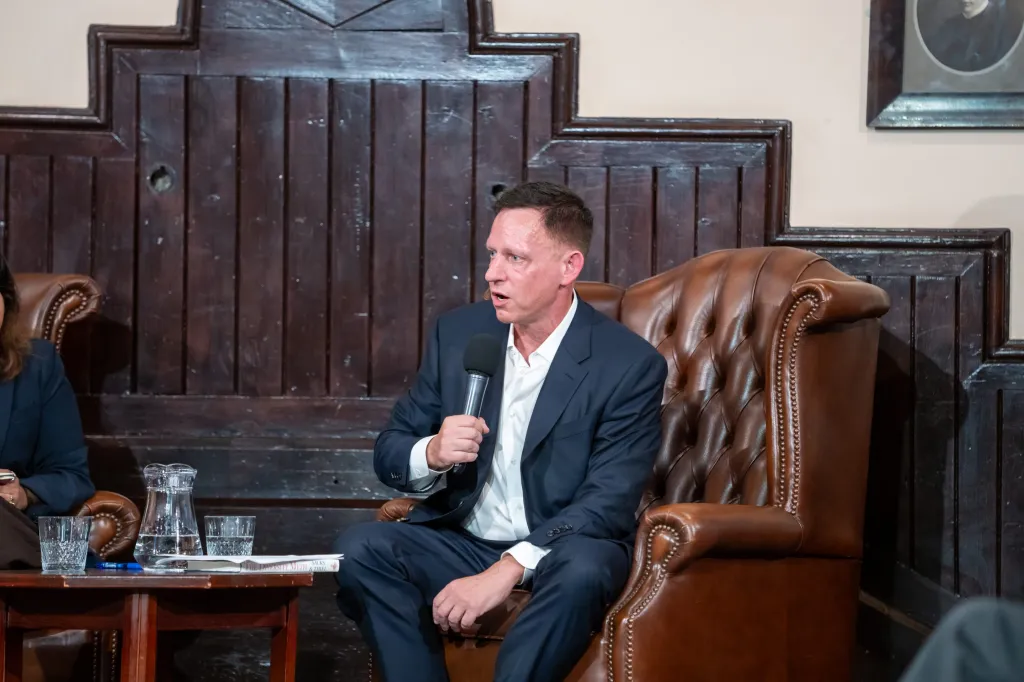
The financial sector, a traditional bastion of stability, is grappling with a looming transformation as artificial intelligence reshapes operational landscapes and workforce needs. This shift echoes a recent observation from tech billionaire Peter Thiel, who suggested that AI’s impact would be felt more keenly by “math people than word people.” His comments, made in a 2024 interview, posited that even in STEM-heavy fields like medicine, the reliance on complex mathematical skills as a primary barrier to entry might diminish.
Recent developments across major financial institutions suggest that Thiel’s forecast may be gaining traction within the broader economy. Block, a fintech firm, announced a substantial 40% reduction in its workforce last month, impacting some 4,000 employees. The company explicitly cited the integration of AI models as a significant driver behind these cuts. This direct link between AI adoption and headcount reduction provides a tangible example of the technology’s immediate effects.
Beyond outright layoffs, a subtler, yet equally impactful, strategy is emerging. Bank of America CEO Brian Moynihan has articulated that AI allows the institution to achieve more with either the same or fewer employees. During an earnings call in January, Moynihan indicated that the bank might not pursue aggressive job cuts but would rather manage its overall payroll by simply choosing not to backfill positions, allowing headcount to naturally decline over time. This approach, focusing on attrition rather than mass dismissals, offers a less disruptive path to efficiency gains.
Wells Fargo CEO Charlie Scharf mirrored this sentiment in December, acknowledging AI’s role in enabling increased output. While no immediate job cuts were announced, Scharf indicated that the bank is exploring opportunities to “do more with less people,” emphasizing that AI would not entirely replace human roles but would fundamentally alter how work is performed. Similarly, JPMorgan’s CFO informed managers in October to limit hiring as the bank integrates AI into its operations. JPMorgan has already deployed a large language model utilized weekly by 150,000 employees, and CEO Jamie Dimon has recognized that the productivity enhancements spurred by AI could lead to a smaller workforce in the coming years.
The trend extends beyond these specific examples. Goldman Sachs, in an October memo, communicated to employees its intention to “constrain headcount growth” and implement a limited number of layoffs. CEO David Solomon underscored the necessity for greater speed and agility, not just in re-tooling platforms, but in fundamentally rethinking how people are organized, decisions are made, and overall productivity is approached. While Citigroup and Morgan Stanley have also recently reduced payrolls, they have not publicly attributed these decisions to AI. Outside of the banking sector, Salesforce cut 4,000 customer support roles last year due to AI integration, and Pinterest adjusted its workforce by nearly 15% to prioritize AI-related positions.
Despite these announcements, some industry analysts express skepticism, suggesting that AI might occasionally serve as a convenient justification for correcting pandemic-era over-hiring. However, the consistent messaging from leadership at these major financial players points to a strategic re-evaluation of human capital in an increasingly automated environment. Interestingly, amidst these shifts, skills traditionally associated with “word people” appear to be gaining value. A recent LinkedIn study highlighted a growing demand for communication and creative thinking abilities. A LinkedIn spokesperson noted that companies are actively seeking strong communicators, with job postings mentioning “storytellers” having doubled over the past year, indicating that while AI handles transactional tasks, human judgment, clarity, and narrative construction remain highly prized.