
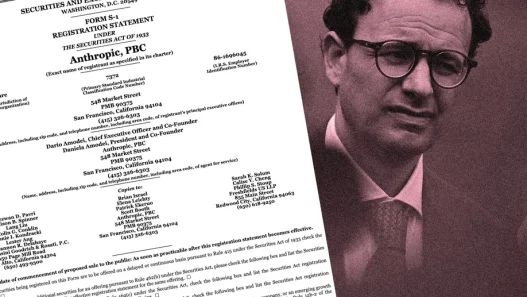





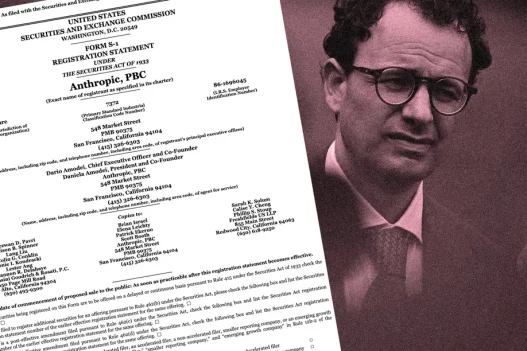
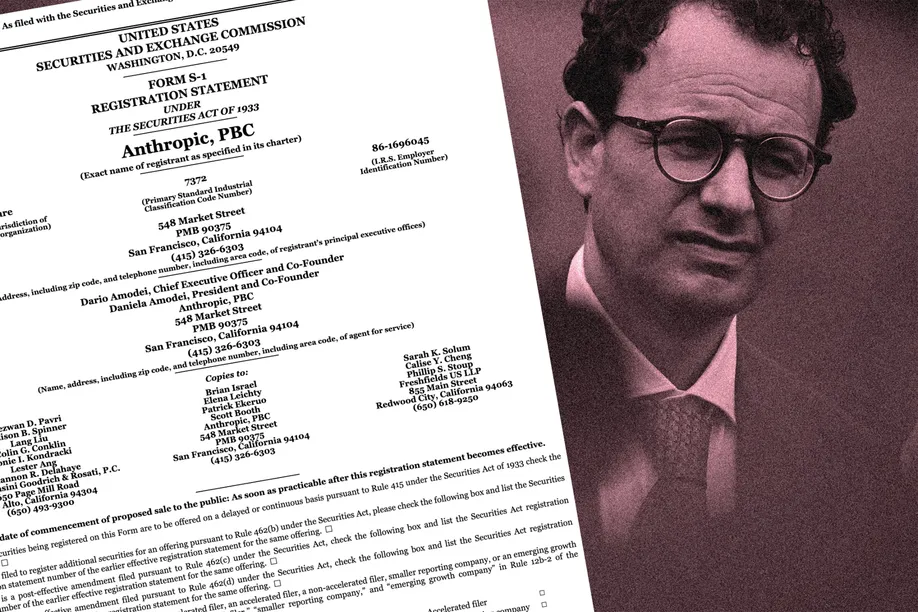
Anthropic filed its Form S-1 with the U.S. Securities and Exchange Commission on 26 October, setting up a Nasdaq listing under the ticker ANT and, with it, the first real look under the hood of one of the world’s most closely watched private companies. The numbers landed at a moment when enthusiasm for the broader AI trade had been fraying, and for investors who had spent two weeks fretting over debt-fuelled data-centre spending, the filing offered something closer to relief than alarm.
The headline figure is growth. Revenue hit $16.3 billion in the first half of 2026, up from roughly $1.2 billion a year earlier, a pace north of 1,300%. Second-quarter revenue alone came to $11.56 billion, growing more than 1,360% year over year. Anthropic also posted its first quarterly operating profit in the second quarter, at $974 million, a detail that matters more than it might appear: it suggests a company whose core business, stripped of accounting noise, is no longer purely burning cash to grow.
That accounting noise is substantial. Anthropic reported an $80.7 billion net loss for the first half of the year, but the bulk of that came from a $72.4 billion non-cash, fair-value charge tied to its convertible financing rather than from operations. Investors parsing the filing have generally read that as a quirk of how the company’s funding rounds are structured rather than a sign of underlying financial distress, which is part of why the filing calmed rather than deepened existing nerves about AI spending.
The customer data backs up the growth story with more than top-line revenue. As of 30 September, Anthropic counted more than 11,900 customers spending at least $100,000 annually, over 1,900 spending upward of $1 million, and roughly 250 spending $10 million or more. That is a meaningfully deeper bench of large enterprise accounts than the company had disclosed previously, and it points to AI spending that is broadening across industries rather than concentrating in a handful of marquee deals.
Anthropic also disclosed $131.7 billion in cash and cash equivalents on its balance sheet as of the end of June, a cushion that analysts have flagged as the clearest sign the company can keep funding its own growth, including the enormous compute costs behind training and running its models, without being forced back to private markets on unfavourable terms.
Valuation chatter has moved along with the disclosures. Some investors had been marking Anthropic at roughly $2 trillion a week before the filing; that figure has since eased toward $1.5 trillion as the market works through the actual numbers rather than speculation. Bankers and prospective investors are now discussing a range broadly between $1.5 trillion and $2 trillion for the eventual IPO pricing, which would still rank Anthropic among the most valuable companies ever to list.
Under SEC rules, Anthropic is free to begin its investor roadshow 15 days after filing, putting a Nasdaq debut as early as mid-November within reach. For a market that has spent recent weeks second-guessing whether AI infrastructure spending can be justified by actual revenue, Anthropic's numbers are the clearest data point yet that at least one of the sector's biggest names is growing into its valuation rather than away from it.
That doesn't mean the skepticism disappears. The size of the non-cash charge, the pace at which compute costs could rise again as the company scales, and the broader question of whether enterprise AI spending holds up if growth decelerates are all likely to be scrutinised hard once the roadshow begins. But for now, Anthropic has done what IPO filings are supposed to do: replace speculation with numbers, and in this case, the numbers argued the bulls' case more than the bears'.