





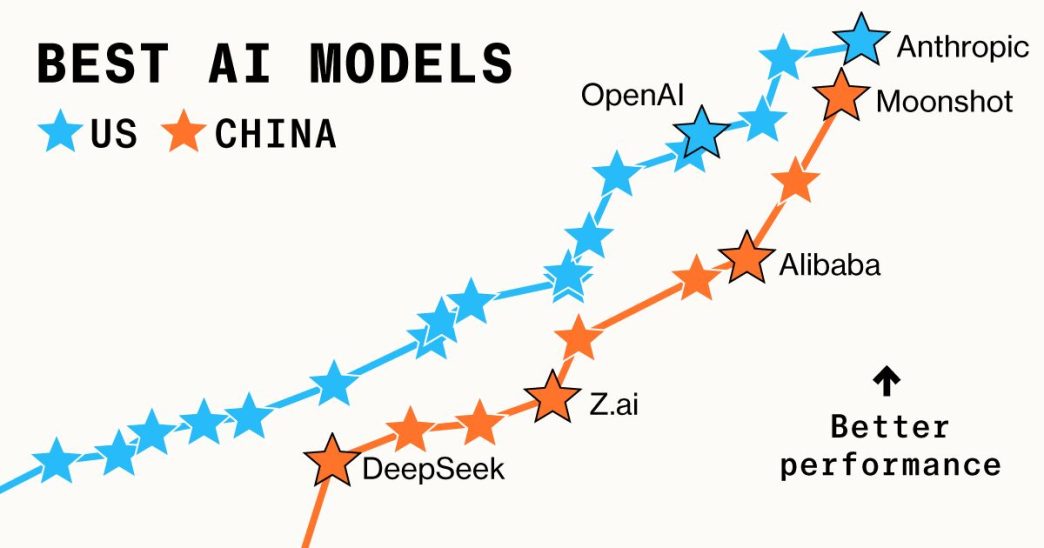
The global AI landscape is increasingly defined by a palpable tension between American and Chinese technological ambitions, a contest playing out not just in government policy but in the very algorithms powering the next generation of digital tools. Consider the recent advancements, where models like OpenAI’s ChatGPT and Google’s Gemini, long at the forefront of public consciousness, now find themselves in a more crowded and competitive arena, particularly with the emergence of powerful Chinese counterparts such as Deepseek and Kimi agents. This dynamic is more than just a battle for market share; it reflects differing philosophical approaches to development, data, and even the fundamental purpose of artificial intelligence itself.
In the United States, the development trajectory has often been characterized by a rapid, iterative release cycle, pushing the boundaries of what large language models can achieve in terms of conversational fluency and multimodal understanding. ChatGPT, for instance, pioneered widespread public interaction with generative AI, quickly becoming a household name and setting a benchmark for accessible intelligence. Google’s Gemini, arriving later, aimed to surpass these capabilities with a native multimodal architecture, designed to process and understand different types of information—text, images, audio, video—seamlessly from its inception. These models have benefited from vast computational resources and an open research culture, albeit one often tempered by commercial interests and a focus on English-speaking markets.
Across the Pacific, China’s AI strategy has been equally ambitious, albeit with distinct characteristics. Companies like Deepseek and Kimi (developed by Moonshot AI) are not merely playing catch-up; they are carving out their own niches and demonstrating formidable capabilities. Deepseek, for example, has showcased models with impressive reasoning abilities and a strong understanding of complex tasks, often outperforming established Western models on specific benchmarks, particularly those relevant to the Chinese language and cultural context. Kimi agents, meanwhile, have garnered attention for their extended context windows, allowing them to process significantly longer documents and conversations, a feature that unlocks new possibilities for long-form analysis and complex information retrieval. This focus on practical applications and robust performance within the Chinese linguistic and digital ecosystem highlights a strategic emphasis on indigenous innovation and self-sufficiency.
The nuances in their development paths are striking. American models frequently emphasize general-purpose intelligence, striving for broad applicability and often leveraging open-source components or a global talent pool. Chinese models, while also aiming for general intelligence, frequently exhibit a more pronounced orientation towards specific national needs, whether in enterprise solutions, content moderation, or highly specialized industry applications. This divergence is also visible in their training data; while American models draw heavily from the English-speaking internet, Chinese models are increasingly trained on vast datasets reflecting the unique characteristics of the Chinese internet and its immense user base.
The implications of this ongoing comparison extend far beyond technical specifications. It speaks to a broader geopolitical contest for technological supremacy, where AI is not just a tool but a strategic asset. The ability to develop, deploy, and control advanced AI systems has profound consequences for economic competitiveness, national security, and even cultural influence. As ChatGPT, Gemini, Deepseek, and Kimi agents continue to evolve, their respective strengths and weaknesses will not only define the future of AI but also illuminate the shifting power dynamics on the global stage, shaping how societies interact with and benefit from these transformative technologies.