







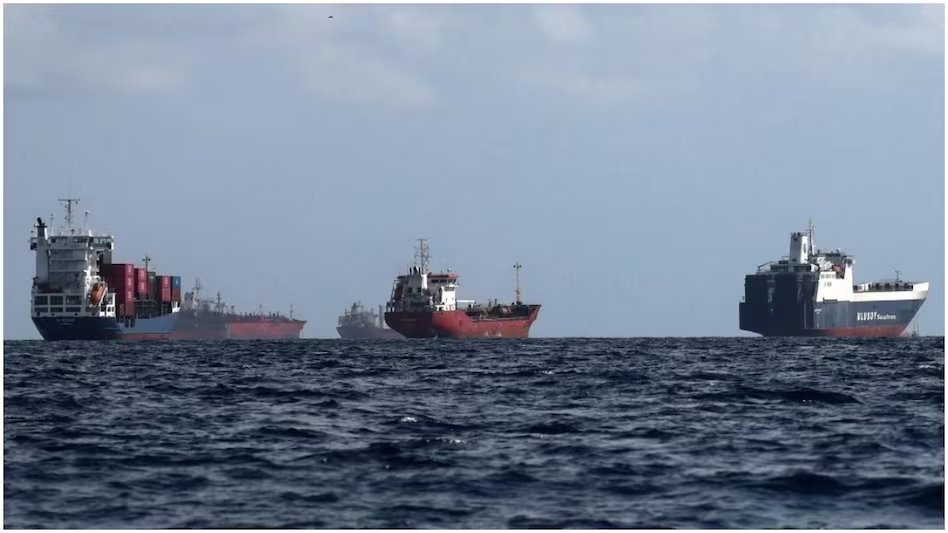
Commercial shipping is increasingly shunning the Strait of Hormuz, particularly a U.S.-backed alternate route, as global oil markets accelerate efforts to circumvent the contested waterway. Despite continued U.S. military assurances regarding freedom of navigation, a week of sustained bombardment has failed to establish a secure passage independent of Iran’s approved channels. This hesitancy among seafarers and national shipping bodies signals a significant shift in how the world’s oil supply could be moved, potentially insulating a substantial portion of pre-war Gulf exports from the strait’s volatility within the next few years.
Last Friday illustrated the stark reality of the situation, with no detectable transits via the U.S.-backed route, nor any movements from the so-called “shadow fleet.” In contrast, Iran’s established channel observed seven crossings, underscoring the ongoing control Tehran exerts over the strategic choke point. The U.S. military’s radio declarations, asserting readiness to safeguard lawful commerce and confirming the southern route’s openness, appear to have done little to assuage concerns. One seafarer’s blunt refusal, captured in a reviewed recording, encapsulates the prevailing sentiment of distrust and fear.
The practical implications of this insecurity are already being felt. India has taken a decisive step, prohibiting its crew members from participating in any transits through the strait following an Iranian attack that resulted in a sailor’s death. Similarly, the Japan Foreign Trade Council has declared the strait a no-go zone for commercial vessels as long as hostilities persist. This collective caution from major maritime nations is a powerful catalyst for the rapid development of alternative export infrastructure, a trend that began in earnest after the significant oil shock triggered by Iran’s earlier closure of the strait.
Before the recent escalation of conflict between the U.S., Israel, and Iran in late February, approximately 20 million barrels of oil traversed the Strait of Hormuz daily. While its initial closure prompted the largest oil shock the world had seen, markets swiftly adapted. This included an increase in “dark” ship movements to avoid detection and a heavy reliance on existing oil stockpiles. More fundamentally, the crisis spurred a renewed focus on land-based diversions. Saudi Arabia’s East-West pipeline and the UAE’s Habshan-Fujairah pipeline have become increasingly critical, supplemented by expanded rail corridors. Iraq, for instance, now sees thousands of trucks ferrying crude to Syrian ports on the Mediterranean coast, with Syria handling more than a quarter of Mideast volumes after having virtually no role just months prior.
The momentum towards bypassing Hormuz is accelerating, driven by both immediate necessity and long-term strategic planning. Kuwait is actively engaged in discussions with Saudi Arabia and the UAE to leverage their expanded pipeline networks for its own oil exports from the Persian Gulf. The UAE is fast-tracking its new West-East pipeline, already 50% complete and projected to be operational early next year, adding to the increased capacity of its Habshan-Fujairah line. Saudi Arabia, too, is expanding its East-West pipeline, further solidifying its alternative export capabilities.
Beyond these immediate projects, older infrastructure is being re-evaluated. A consortium, including Chevron, is reportedly exploring the reconstruction of the pipeline from Kirkuk in northern Iraq to the Syrian port of Baniyas on the Mediterranean, a route damaged two decades ago during the Iraq war. Turkey has also put forward a proposal to extend the Kirkuk-Ceyhan pipeline south to the Iraqi port of Basra on the Gulf coast, which would create another direct Mediterranean export channel, considerably reducing dependence on Hormuz.
Analysts at Goldman Sachs recently projected that by the end of next year, enough new Mideast pipeline capacity will likely be in place to insulate over 45% of pre-war Gulf exports from the strait. This figure could climb to more than 60% by the close of 2028, with an “accelerated scenario” potentially pushing it to 75%. The median construction time for pipeline projects in the region is estimated at 2.5 years, a timeline that typically shortens in response to supply disruptions, suggesting that the drive for energy independence from the Strait of Hormuz is not only strategic but also achievable in the near term.